
Your Cart
Your shopping cart is currently empty.
Eco & Save
Reduce your carbon footprint and your utility bills by getting more energy efficient and water-wise.
ECO & SAVE | 3 DECEMBER, 2025
6 MIN READ
Why food scraps are a bigger problem than you think
There’s a better way to dispose of food waste
When you toss that mouldy bread or those veggie scraps in the rubbish bin, you probably don't think much about what happens next. But that innocent-looking food waste is actually creating a powerful greenhouse gas.
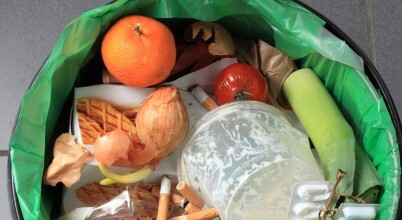
Putting food waste in general rubbish bins should be avoided whenever possible
The hidden danger in your waste bin
Every year, Australian households throw away tonnes of food waste. Some of it's unavoidable stuff, like apple cores, egg shells and coffee grounds, while the rest of it is leftovers we never got around to reheating or veggies and other fresh produce we bought with the best intentions but never used. When all this organic waste ends up in landfill with our regular rubbish, something problematic happens underground.
In a landfill, your food scraps get buried under layers and layers of other waste. Down there, there's no oxygen. And when food breaks down without oxygen - a process called anaerobic decomposition - it produces methane gas.
What makes methane so bad?
While carbon dioxide contributes to climate change, methane is even more powerful. In fact, according to the UN Environment Programme, methane is 80 times more potent than carbon dioxide at warming the atmosphere over a 20-year period. These emissions from organic material breaking down in landfill are a significant contributor to Australia's carbon footprint.
Think about that for a moment. A banana peel thrown in a bin last week isn't just rotting - it's actively contributing to global warming.
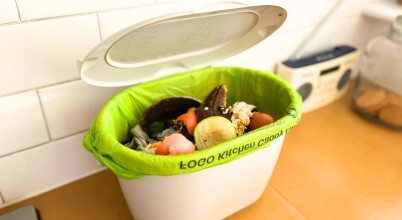
A FOGO (Food Organics Garden Organics) kitchen caddy for collecting food scraps
Council composting programs
The good news is that more councils across Australia are now rolling out separate food waste collection programs. In NSW, for example, around 31% of households had a FOGO (Food Organics Garden Organics) bin in 2023-2024, but legislation passed in 2024 has made it mandatory for 100% of councils to offer this service by 2030.
Your council may have already supplied you with a countertop kitchen caddy that makes it easy to collect organic waste throughout the day before transferring it to your green lid bin, which can take food scraps as well as garden waste.
This isn't just about keeping your bins organised. It's about completely flipping the impact of your food waste, from negative to positive.
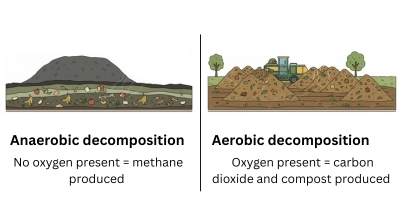
Decomposition of food waste in landfill versus composting
From problem to solution
When councils collect your food waste separately through your organic bin or green waste bin, they take it to composting facilities instead of landfill. At these facilities, food scraps are broken down in a completely different way - with plenty of oxygen present. This composting process is called aerobic decomposition.
The difference is huge. Instead of creating methane, it produces mainly carbon dioxide and water vapour - far less harmful to the environment. Even better, the end result is nutrient-rich high quality compost that can be used in gardens, parks, and farms.
So, your old banana peel that would have created powerful methane gas? Now it becomes soil that helps plants grow.
What can you put in council food waste bins?
Here's what you can typically put in your food waste bin if it’s collected by council:
Fruit and vegetable scraps
Meat, fish and bones
Cheese, yogurt and other dairy
Bread, pasta and rice
Coffee grounds and loose-leaf tea
Egg shells.
Most councils with FOGO programs provide small compostable bags and kitchen caddies to take the ick out of collecting food scraps. Just scrape your plates into the caddy’s little biodegradable bin liners, and then pop them in the outdoor green lid bin when they’re full. Many kitchen caddies are also dishwasher-safe.
If your council’s scheme also accepts food-soiled, uncoated cardboard and paper food packaging, like burger and pizza boxes and fish and chip cartons, you can put these directly into the outdoor green bin.
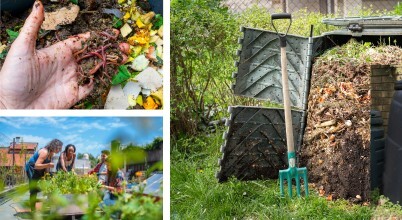
Non-council composting options include worm farms, backyard compost bins and community gardens
What if your council doesn't have a food waste program yet?
Don't worry - even if there’s not an option to send food waste to a council composting facility, you've still got options to keep your food scraps out of landfill:
Start home composting: A backyard compost bin is perfect for veggie scraps, coffee grounds, egg shells, and garden waste like grass clippings and leaves. You can find affordable compost bins at most hardware stores, and many councils offer discounted or free bins to residents. You won’t want to head outside every time you peel a banana, though, so get yourself a small food scrap bin for the kitchen and then empty it into the outside compost whenever it’s full. Just remember that home composting is for plant-based materials. Unlike council-run food waste recycling, meat, fish and dairy are best avoided in backyard compost systems, as they decompose slowly, smell bad and can attract rats, flies or other pests.
Try a worm farm: Worms are excellent at breaking down food scraps into nutrient-rich compost. A worm farm can sit on your balcony or in a small courtyard, making it perfect for apartments or homes without much outdoor space. Worms love most kitchen scraps - but go easy on citrus and onions.
Look for community composting: Some areas have community gardens or composting hubs where you can drop off your organic waste. Check local Facebook groups or community noticeboards to see what's available near you.
Contact your council: Let your local council know you'd like to see a food waste service introduced. The more residents who ask for it, the more likely councils are to prioritise setting up a program. Fewer than half of Australian councils currently offer a food waste collection service, but lots are planning to roll one out in the next few years, so your voice could help speed up the process.
The bigger picture
Climate change can feel overwhelming, and sometimes it's hard to know where individual actions fit in. But separating your food waste can genuinely make a difference. When thousands of households in your area keep food out of landfill, the reduction in methane emissions is significant.
Plus, the quality compost created from all that food waste helps build healthier soil, which can actually store carbon from the atmosphere.

Oli is Appliances Online's editor and blogger, with almost two decades of lifestyle-related writing and editing to his name. With a mission to help you buy better and live smarter, his brand loyalty will forever belong to the appliance manufacturer that develops a self-emptying dishwasher.
Latest Articles
KITCHEN
18 MARCH 2026
How to get the most from your oven
Handy settings and other simple tips
KITCHEN
10 MARCH 2026
4 reasons you should never plug your fridge into an extension cord or power board
Fridges run 24/7, so give them their own wall socket!

BLOG HOME
9 MARCH 2026
True South: A race to remember
Legacy and spirit in the Sydney to Hobart yacht race
KITCHEN
5 MARCH 2026
5 of our top best selling slow cookers in Australia 2025-26
Make Autumn easy with one-pot, slow-cooked meals.
More Like This
KITCHEN
18 MARCH 2026
How to get the most from your oven
Handy settings and other simple tips
KITCHEN
10 MARCH 2026
4 reasons you should never plug your fridge into an extension cord or power board
Fridges run 24/7, so give them their own wall socket!
BLOG HOME
9 MARCH 2026
True South: A race to remember
Legacy and spirit in the Sydney to Hobart yacht race