
Your Cart
Your shopping cart is currently empty.

Taking care of your car can be an important part of your home maintenance routine, as is ensuring you have the right tools to get you back on the road when driving. This buying guide will take you through some integral tools you can use to enhance your driving experience, whether it’s an air compressor to keep your tyres pumped, GPS navigation to ensure you stay on the right path, or breathalysers to make sure it’s safe for you to be behind the wheel.
What is an Air Compressor?
Whether it’s to power air tools or to inflate your car tyres, an air compressor is a versatile tool to include in your home maintenance arsenal. An air compressor works by forcing air into the tank under high pressure. You can then use this stored air to undertake a variety of different tasks around the home or in your garage.
Ensuring your tyres are filled with the proper volume of air is one of the most important tasks you can undertake when looking after your car - after all, your tyres are the vital link between your car and the road surface. Not only being beneficial for driving comfort, safety, braking, and handling, properly-filled tyres aid in improving fuel economy.
When looking at an air compressor, it’s important to consider the tank capacity and the horsepower. The tank capacity dictates how much air can be stored in the tank at a single time to provide you with a generous supply for all your outdoor tasks. A higher horsepower indicates how efficient the compressor is at refilling the tank and reducing the recovery time.
It’s also important to look for an air compressor with a clear pressure gauge to ensure you can fill your tyres with the correct volume of air.
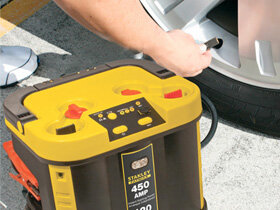
What can Air Compressors be used for?
An air compressor is used for a large number of different jobs around the home, including filling your car tyres with air and powering air tools.
Due to the blasts of pressured air, air compressors can also be used to clean gutters and the grout between pathways, as well as being able to blow up sports balls and pool toys.
Work Lights
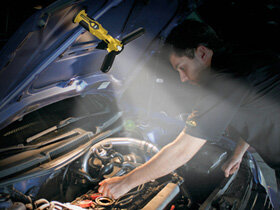
Illuminate every Task
Sometimes you need to do some work on your vehicle and to help maintain optimal visibility, a work light is the optimal tool. A work light enables you to illuminate harder-to-access areas such as underneath the hood, under the car, or in the boot.
When shopping for the ideal work light, you should ensure it has plenty of brightness for your particular job or general use. The brightness of the bulb is generally measured in lumens - the higher the lumens, the brighter the bulb will be. For a comparison, a typical 60 watt light bulb you might use in your home will give off around 800 lumens worth of light.
It’s also good to note the battery life of a work light, to ensure it will last for the full time you need to utilise it. You may also wish to check for handy features such as magnetic bases or bendable stands, allowing you to perform your task with both hands, while the light illuminates the area.
Jump Starters
A necessary part of the gear in your car, a jump starter is not only great for powering phones and other devices but is also integral to putting some juice back into your car battery. Designed to be portable, jump starters are suitable both for home use and for roadside applications.
It’s important to note that battery-powered jump starters need to be recharged, usually with a home power cord. This is different to jumper cables which connect from one car to another.
When looking for a jump starter, it’s good to look for a pack with a high battery capacity, as well as safety features such as reverse polarity alarms, alerting you if there’s an improper connection.
Some jump starters also utilise additional connections for user convenience, such as 12-volt and USB connections to charge personal electronics, integrated work lights, and smaller air compressors.
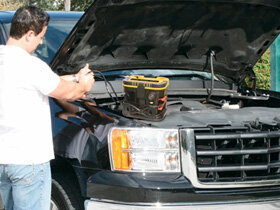
How to use a Jump Starter?
When using a jump starter, it’s important to ensure there’s plenty of charge in the jump starter itself, otherwise you won’t be able to channel much power. The jump starter is generally utilised by first connecting the red cable to the positive terminal on your battery, followed by the black cable to the negative terminal on your battery. You then need to turn the jump starter on and start your car. Simply let your car idle for a few moments with the jump starter connected, before turning the car off, turning the jump starter off, and disconnecting the cables in reverse order,
However, it’s important to read through your jump starter’s operating instructions, as well as your vehicle manual, so you understand the proper, specific method to undertake.
Breathalysers
A breathalyser is a safety device which measures the amount of alcohol in your body. They can help determine whether or not you’re safe to work or drive. However, it’s important to note that if you intend to work or drive, the optimal BAC (blood alcohol content) is zero.
Many people may be familiar with the breathalysers utilised by the police force and the range of breathalysers at Appliances Online function in an identical fashion, using built-in sensors to detect alcohol levels in the body. We have a variety of breathalysers, with some designed for professional scenarios and others developed for personal use.
Following on from this, it’s paramount to match your breathalyser with your need. A personal breathalyser may be optimal for you, able to be kept in the glove compartment of your car or in your bag and is ideal for quick checks, while a professional model can be utilised more times before needing recalibration.
When shopping for a breathalyser, it’s important to note the BAC range and accuracy of the device, which will help ensure a precise and accurate reading. You should also make note of the warm up time and response time of your breathalyser, which affects how long your unit takes to turn on and how long it needs to take a reading, respectively.
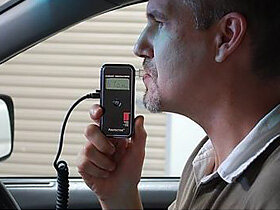
How does a Breathalyser Work?
As alcohol circulates around the body, it is eventually diffused into your lungs. Using a specialised internal sensor, the alcohol content on your breath is detected and analysed to provide a BAC reading. Due to constant exposure to alcohol molecules, the sensor needs to be recalibrated after a certain timeframe or after a set number of uses, to maintain accuracy.
GPS and Navigation
Your tyres are pumped, you’ve got fuel in the car, and your battery is charged, but you don’t know where to go. A GPS will help you stay well on track so you can arrive at your destination in a safe and timely manner. But choosing the right GPS can be challenging, as not all navigation devices are the same.
Some GPS’ are designed for heavy vehicles, such as trucks, some are designed for off-roading, while others are developed for road use by cars. So it’s a good idea to always check you get the right GPS for your vehicle type and general use.
Many navigation systems also feature additional functions designed for safe and efficient driving, such as live traffic updates, voice prompts warning of potential collisions, landmark guidance, and notifications about upcoming red light cameras or speed cameras.
If you desire a more multifunctional navigation system, some GPS devices come equipped with dash cam functionality as well as additional accessories such as tire pressure monitoring.
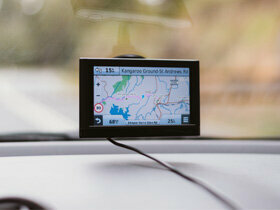
How to Update the GPS Maps in a Car?
Most GPS devices from top brands offer free map updates, as new roads are forged through new areas. The method for updating your GPS may depend on the model you own, so it’s important to check the manufacturer instructions or website.
Dash Cams
A dash camera is designed to monitor the exterior of your vehicle, recording video in the case of an incident or collision. The first consideration when looking for a dash cam is to determine what type of camera you need.
Do you want a camera which just records in front of you? Behind your vehicle? Both? Do you want a model with an integrated screen/monitor? Do you want a monitor which can replace your factory-installed rear view mirror? Once you figure out what type of camera you want or need, you can look further into the features of each model.
When looking at different models, it’s good to note the FOV (field of view) the camera can view at any one time. There are also models which feature location and speed tracking, pairing live footage of your trip with your journey tracked on Google Maps.
Of course, one of the most important features to look for is a G-Sensor, which automatically records and saves the footage when a collision is detected, preventing it from being recorded over. This footage can be transferred and viewed on your smartphone, if the dash cam features Wi-Fi connectivity.
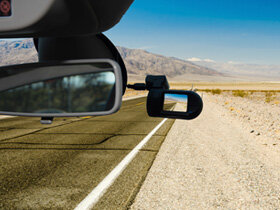
Where Should you Place your Dash Cam?
The placement of your dash camera is ultimately up to you and the type of camera you have chosen. For example, a mirror camera is designed to replace your factory-standard rear view mirror.
To get the best view possible while driving, a dash camera is ideally placed in the centre of the windshield, towards the top of your car. This places it roughly behind the rear view mirror. But check with the instructions that come with your camera or the manufacturer’s website, to ensure the best placement for your particular camera.